
Your wedding day should feel relaxed, joyful, and completely yours.
I’m Alex Kaplan, a wedding photographer and videographer based in New Milford, NJ, serving Northern NJ, NYC, and the Hudson Valley. For over 30 years, I’ve helped couples enjoy their day without feeling rushed, while I quietly capture the real moments, natural portraits, and genuine emotions you’ll still love decades from now.
Browse by Category:
WEDDINGS
Browse by Venue:
view more

REQUEST INFORMATION
Want to feel like THIS on your wedding day?
Availability is limited. Check Your Date Here
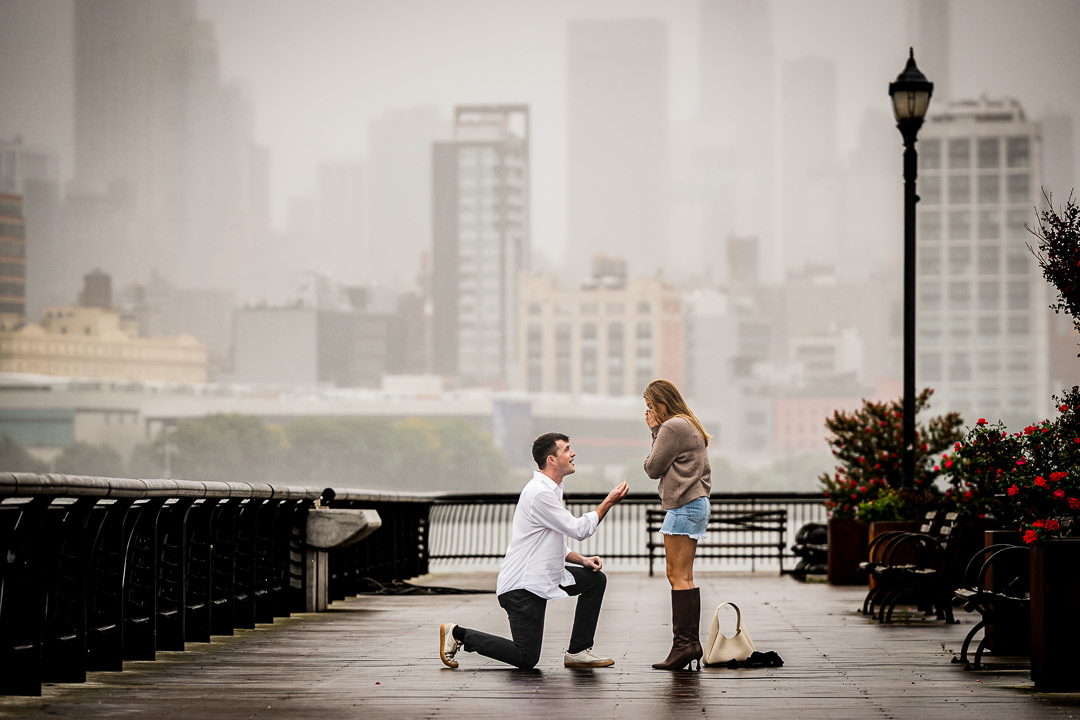
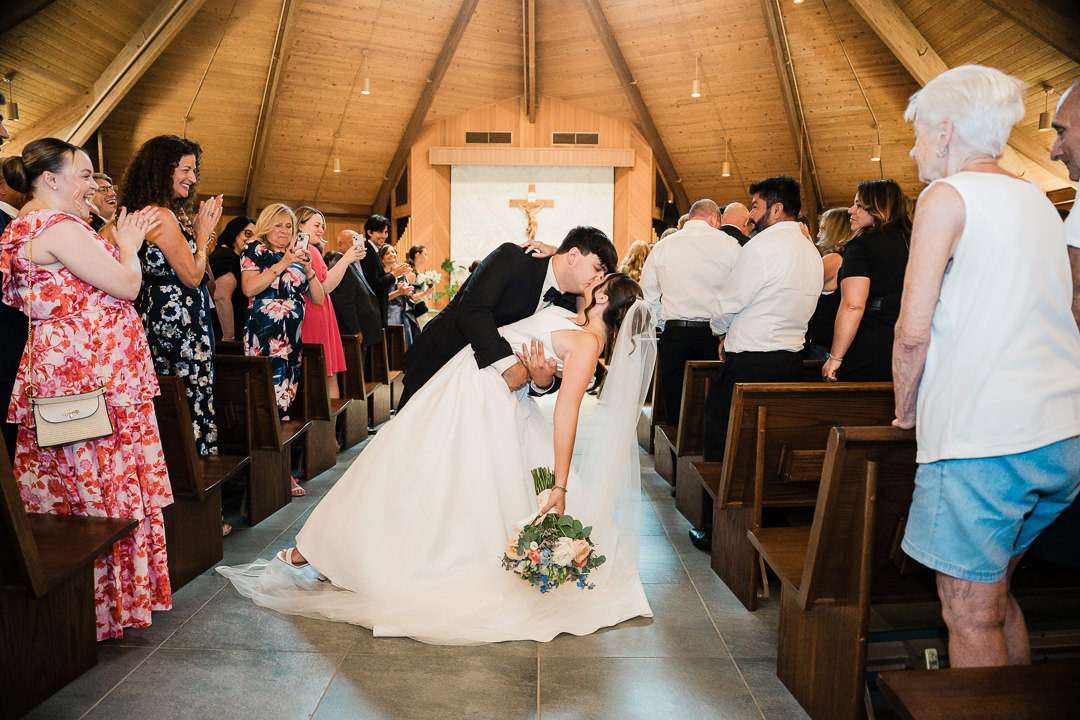


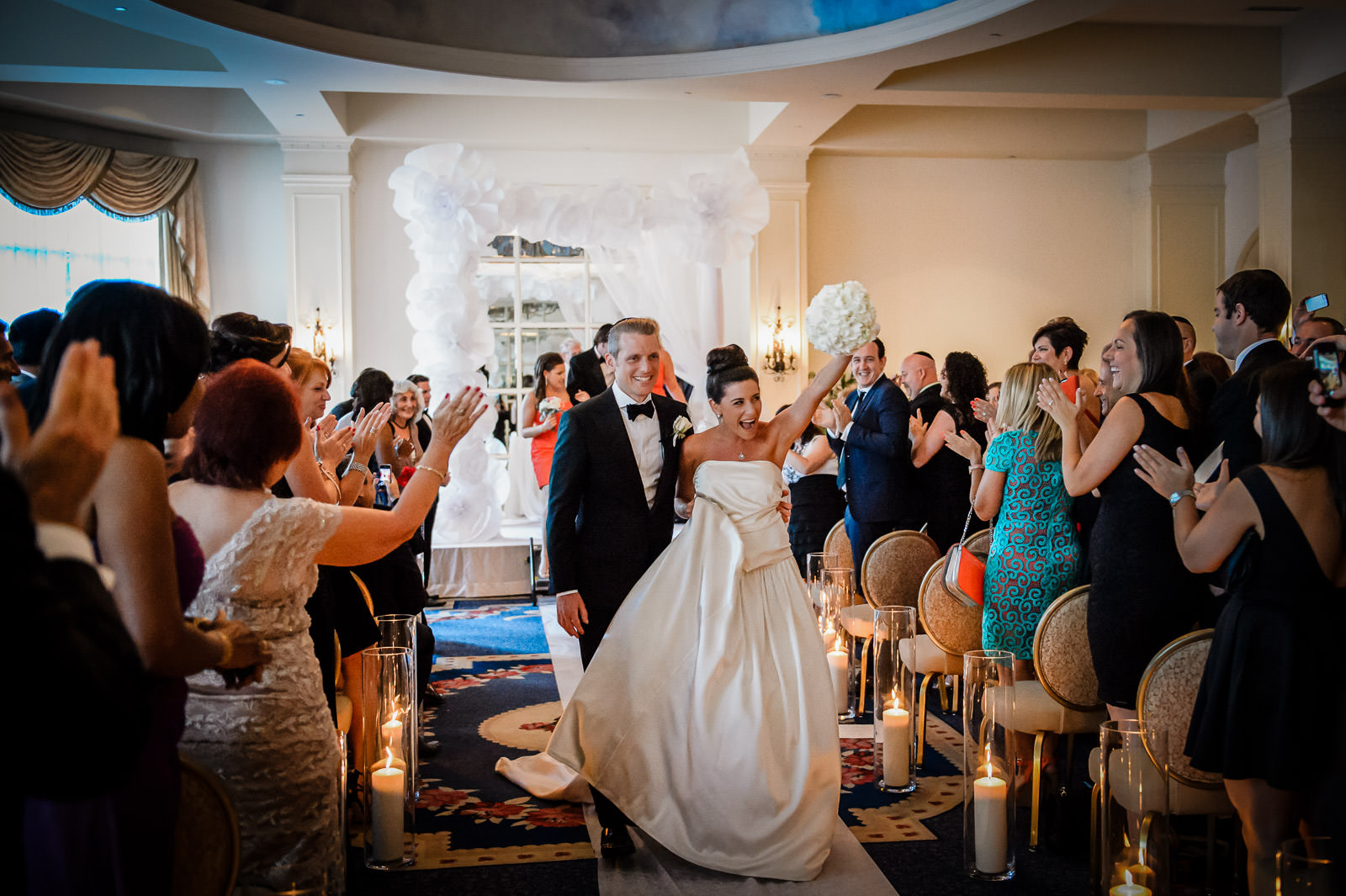
Some of the most emotional wedding photos I capture aren’t carefully posed portraits. They happen naturally in the few seconds right after the ceremony ends, when the bride throws her bouquet in the air, the groom is still catching his breath, and every guest in the room is on their feet with their hands above their heads.
That’s the recessional. And in more than 30 years as a New Jersey wedding photographer, I’ve learned it’s one of the few moments on a wedding day that can’t be replicated, rehearsed, or recreated later. Which is exactly why I never stage it.
What Is a Wedding Recessional?
A wedding recessional is the moment immediately after the ceremony when the newly married couple walks back down the aisle together while guests celebrate and applaud. It is often one of the most emotional and energetic parts of the wedding day, creating authentic photo opportunities filled with joy, movement, and real reactions.
The Knot describes the recessional as the formal close of the ceremony, but for most couples, it’s also the first time they exhale all day. The vows are said. The rings are exchanged. The thing they’ve been planning for a year or more is suddenly, finally, real. And in those eight or ten seconds it takes to walk back down the aisle, something shifts in their faces that I cannot direct, suggest, or fake.
Why the Recessional Creates Some of the Most Emotional Wedding Photos
There’s a real reason these moments photograph so beautifully. Couples have just stood through the most emotionally weighted ten minutes of their adult lives. The pressure releases all at once. You see it in their shoulders, in the way they grip each other’s hands, in the laughter that breaks through tears they didn’t know they were holding back.
A bride throwing her bouquet in the air with her arm fully extended isn’t a pose anyone would think to ask for. It’s pure adrenaline. A groom looking sideways at his new wife with a half-disbelieving grin isn’t something you can prompt. He’s just realized what happened.
This is what I work to protect on every wedding day, and it’s the core of how I approach authentic wedding photography in New Jersey. The minute you ask a couple to “do it again, but slower,” you’ve lost it. The emotion was tied to the moment itself, and the moment is already gone.
What Makes Authentic Wedding Moments Photograph Better
There’s a real difference between a beautiful photo and a photo that means something to the people in it. Both can be technically perfect. Only one tends to survive twenty years on a wall.
Authentic moments carry information that staged moments don’t. Body language that hasn’t been corrected. Micro-expressions that haven’t been smoothed away. A bridesmaid in the background wiping her eyes. A grandfather standing when he probably shouldn’t be. The slight blur of a hand in motion because someone was clapping too hard to hold still.
When I photograph a real wedding moment, I’m capturing context, not just the couple, but the room full of people who love them and what those people were doing at the exact same second. That’s what makes candid wedding photography in NJ different from traditional wedding photography. The story is in the periphery as much as the subject.
Why I Never Fully Stage the Recessional
Early in my career, I’d watch other photographers stop a couple halfway down the aisle, ask them to pause, then walk back to the chuppah or altar and do it again “for the shot.” I understood why — the first pass happens fast, the light is tricky, and a second take gives you a guaranteed frame.
I stopped doing that years ago. Here’s what I noticed: the second take is always worse. The couple is self-conscious now. The guests have sat back down. The momentum is broken. You end up with a clean, well-lit, completely lifeless photo of two people walking. Technically fine. Emotionally empty.
So I make a different trade. I shoot the recessional once, the way it actually happens, and I trust my instincts and my equipment to handle whatever the room gives me. That means knowing where to stand before the kiss happens, anticipating which direction the couple will turn, and being ready for the bouquet hand to go up before the bouquet hand goes up.
It also means accepting that some frames won’t be perfect. A guest’s hand might cross in front of the lens. The focus might land on the wrong eye for a half-second. But the frames that do land, those are the ones couples send to me a year later saying this is the photo we framed.
The Guest Reactions Often Matter Just As Much
One of the things I’ve come to appreciate is how much of the wedding day is actually carried by the people watching it. The recessional is the clearest example.
Look around the room during those few seconds and you’ll see the wedding everyone forgets to plan for. The mother of the bride covering her mouth. The college friends in the back row doing something undignified and joyful. The little nephew who has no idea what’s happening but is clapping because everyone else is. The aunt with her phone out, getting a vertical video that will be terrible but that she’ll watch a hundred times.
I make a point of turning around. Not just shooting the couple, but shooting what the couple is walking into a tunnel of people who are, for that one moment, entirely focused on celebrating them.
When couples look at their gallery later, they almost always linger longer on the guest reaction frames than on the portraits. Portraits show what they looked like. Guest reactions show what their day felt like. Both matter. Only one of them is irreplaceable.
Documentary Wedding Photography Is About Anticipation
People sometimes assume that being a documentary wedding photographer in NJ is about reacting quickly. It’s actually the opposite… it’s about anticipating slowly.
By the time the recessional starts, I’ve already read the room. I know which side the bride’s family is sitting on, which uncle is going to whistle, where the officiant will step aside, whether the aisle is wide enough for me to back down it without tripping over a candle. I’ve watched the rehearsal in my head. I’ve already chosen my lens and confirmed my settings. I know what the kiss looks like from where I’m standing, and I know the half-second I need to pivot to catch the first step back up the aisle.
None of that is visible in the final photo. But all of it is the reason the photo exists. Documentary work isn’t passive. It’s prepared.
That preparation is what lets me stay out of the way. The couple should never feel like they’re being directed during their own ceremony. The guests should never see a photographer asking them to clap harder or smile bigger. The moment should feel, to everyone in the room, like it’s happening to them — not for the camera.
Why Couples Connect More Deeply With Real Wedding Photos Years Later
There’s a test I think about a lot: which wedding photos do couples still display in their home five or ten years after the wedding?
In my experience, it’s almost never the formal portraits. Those tend to get printed once, hung briefly, and quietly retired. The photos that stay up are the ones that show something real..a parent’s face during the vows, the unguarded laugh during the first dance, the recessional moment when both people looked like they couldn’t believe their luck.
Those photos hold up because the emotion in them is honest. A posed smile ages. A real one doesn’t. Twenty years from now, that bride will still recognize the exact feeling on her own face in a recessional frame, because it’s the same feeling she actually had. There’s nothing in it to second-guess.
That’s the entire argument for natural wedding photography in NJ in one sentence: it ages better because it was true to begin with.
What Are the Best Wedding Recessional Photo Ideas?
The honest answer is that the best recessional photo ideas aren’t ideas at all, they’re conditions you set up so the real moment can happen.
Walk slowly. Most couples sprint down the aisle because adrenaline takes over. Half a second per step gives a photographer time to actually catch what’s on your faces.
Stop once, briefly, around two-thirds of the way down. Not to pose, just to take it in. Look at each other. Kiss again if you feel like it. That pause, when it’s real, produces some of the strongest frames of the entire day.
Tell your guests in advance to keep their phones down during the ceremony, but to go ahead and celebrate during the recessional. The reactions get bigger when people aren’t filtering themselves through a screen.
Skip the rice, bubbles, and petals unless they genuinely fit your wedding. They photograph beautifully in some venues and look like a craft store exploded in others. If you do use them, brief the guests so the throw happens as you pass, not before.
And then forget all of it. The couples who get the best recessional photos aren’t the ones who plan the recessional. They’re the ones who let it happen.
The Best Wedding Moments Usually Aren’t Forced
If you’re a couple deciding what kind of wedding photographer you want, the choice usually comes down to this: do you want photos of your wedding, or do you want photos of a wedding that looks like yours?
There’s a place for posed portraits, I shoot them on every wedding I photograph, and I take them seriously. But the photos that tend to mean the most, years later, are the ones nobody asked for. The bouquet thrown in the air. The guest in the third row crying into her napkin. The groom catching his wife’s eye halfway up the aisle and grinning like a kid.
Those moments only happen once. My job is to be ready when they do.
If you want wedding photos that feel honest years from now, not overly posed or forced, this is the kind of storytelling I care most about. You can see more of this approach in our real wedding moments gallery, or contact Alex Kaplan Weddings when you’re ready to talk through your day.
Reply...
The Calm Behind the Camera
About Me — But Really, It’s About You
The most meaningful wedding photos never come from stiff poses.
They come from the quiet laugh you didn’t think anyone saw.
The look on your partner’s face during the vows.
The warmth of your people all around you.
I’ve been doing this for over 30 years — and I still get nervous before every wedding.
Not because I’m uncertain, but because I know how much it matters.
After photographing hundreds of weddings over the past few decades, I’ve learned something simple:
The best photos happen when you feel fully present.
That’s why I work calmly, behind the scenes — guiding when it helps, then stepping back when the real moments unfold. I’m always anticipating what’s next, so you never have to think about a thing.
My goal is simple: to help you relax, feel confident, and walk away with photos that feel like you — not a filtered version of someone else’s idea of perfect.
Most of my couples say the same thing:
“We’re so glad we didn’t have to worry.”


trusted by over 800 couples In NYC & NJ you’re in great hands.
201-834-4999 | 917-992-9097
alex@alexkaplanweddings.com
Let’s Connect
alex@alexkaplanweddings.com
917-992-9097
I’d love to hear what you’re planning. I’ll personally reach out to learn more and see how I can help.


